Where Art Meets Seaweed Pancakes in Sokcho
You know that feeling when a place just gets you? Sokcho hit me like a fresh sea breeze—unexpected, vibrant, real. I went for the mountains, stayed for the food, and left realizing everything here is art: from fish market sketches to steaming bowls of milmyeon. This isn’t just cuisine—it’s culture on a plate, painted with bold flavors and quiet tradition. Let me take you behind the scenes. In Sokcho, creativity doesn’t live in galleries alone. It spills onto sidewalks, sizzles in street-side pans, and floats in the salty air near the harbor. Here, art is not something you merely observe. It’s something you taste, hear, and feel in the rhythm of daily life. This city, nestled between the East Sea and the forested slopes of Seoraksan, offers a rare kind of authenticity—a place where beauty arises not from perfection, but from presence.
First Impressions: A City That Feels Like a Sketchbook
Sokcho greets visitors with a quiet confidence, unpolished but full of character. As you step off the bus or drive in from the coastal highway, the first thing you notice is the light—crisp and silvery, reflecting off the water like scattered mica. The city doesn’t dazzle with grand architecture or manicured plazas. Instead, it unfolds like a sketchbook left open on a park bench: unfinished, alive, and deeply personal. Buildings wear their years with grace, their facades marked by salt spray and sun, their colors softened by time. Near Dongmyeong Port, the scent of brine mingles with the smoky char of grilled squid from roadside stands, creating an olfactory map of the city’s soul.
Sound plays its part too. The low hum of fishing boats returning at dawn blends with the chatter of early risers at outdoor markets. Fishermen in weathered hats mend nets on the pier, their hands moving with the precision of artisans. Nearby, a street vendor arranges radish kimchi in neat rows, the pinkish cubes glistening under morning light. These moments are not staged for tourists. They are the quiet theater of ordinary life, unfolding in full view. There’s poetry in the way an old woman folds dumplings with practiced fingers or how a delivery scooter zips past a mural of a whale leaping over the city skyline. Sokcho’s charm lies in this seamless blend of the natural, the urban, and the human.
Even the city’s relationship with its surroundings feels artistic. To the west, the jagged peaks of Seoraksan National Park rise like a backdrop from a traditional ink painting. To the east, the East Sea stretches endlessly, its waves whispering against the shore. This duality—mountain and sea—shapes Sokcho’s identity. It’s a place of contrasts: rugged yet serene, busy yet contemplative. The air carries a sense of movement, as if the city itself is breathing in time with the tides. For visitors, this creates an immediate sense of grounding. You don’t just see Sokcho—you feel it in your bones, a gentle reminder that beauty often resides in the in-between spaces.
The Canvas of the Fish Market: Where Freshness Becomes Theater
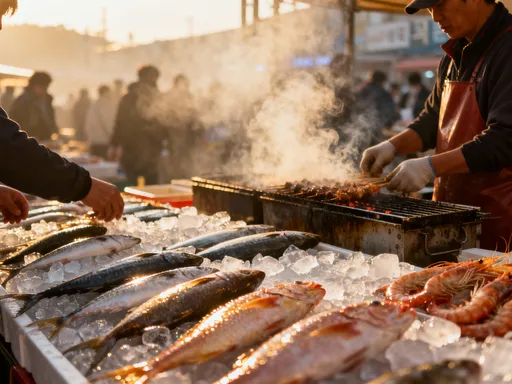
At the heart of Sokcho’s cultural rhythm lies its central fish market, a place where commerce and artistry merge in the most unexpected ways. More than just a place to buy seafood, the market functions as a living gallery, where every stall is a still-life composition and every vendor a performer. As you walk through the narrow aisles, your senses are overwhelmed in the best possible way. Crates of snow crab tower like icy sculptures. Octopuses coil in glass tanks, their tentacles drifting like underwater dancers. Translucent jellyfish pulse gently in cold water, their delicate forms resembling bioluminescent chandeliers.
The real magic, however, lies in the human element. Vendors call out their daily catch with rhythmic flair, their voices rising and falling like a chorus. Knives flash as fish are scaled and filleted with astonishing speed, the sound of steel on scale adding percussion to the market’s soundtrack. This isn’t just preparation—it’s performance. The act of selecting a live fish, watching it transformed before your eyes, and then eating it minutes later turns dining into a multisensory ritual. It’s a form of culinary theater, where freshness is not just a claim but a visible, audible, and tangible experience.
For many visitors, the highlight is trying hoe, a dish of raw fish served with sesame oil, garlic, and spicy gochujang. The fish—often sea bream or mackerel—is sliced so thinly it glistens like silk. Equally iconic is jeotgal, a category of fermented seafood that ranges from spicy shrimp paste to salted pollock roe. These foods are not for the faint of heart, but they speak to a deep-rooted tradition of preservation and flavor layering. In Sokcho, eating is not passive. It’s participatory, intimate, and deeply connected to the sea. The fish market, in all its raw energy, embodies the city’s ethos: vibrant, unfiltered, and alive with meaning.
Milmyeon: The Noodle Dish That Tells a War Story
No visit to Sokcho is complete without tasting milmyeon, a cold noodle soup that carries the weight of history in every bite. More than just a local specialty, milmyeon is a culinary heirloom, born from displacement and resilience. Its origins trace back to the Korean War, when refugees from North Korea settled in Sokcho and adapted their traditional naengmyeon recipe using locally available ingredients. Without access to the sweet potato starch noodles of the north, they turned to buckwheat and potato starch, creating a chewier, more elastic texture that became the signature of Sokcho-style milmyeon.
The dish itself is a study in contrasts. A bowl arrives steaming at first, then quickly cools as the icy broth melts. The noodles, firm and slightly translucent, swim in a tangy, vinegar-kissed beef or dongchimi (radish water kimchi) broth. Toppings are simple but deliberate: a slice of boiled egg with a golden yolk, a fan of sliced cucumber, and the bright pink disc of danmuji, pickled radish. Each element plays a role—not just in flavor, but in symbolism. The pink radish echoes the colors of home; the cold broth reflects the harsh winters of the north; the chewy noodles speak to endurance.
Milmyeon is more than sustenance. It’s a story on a plate, a quiet act of remembrance. Eating it feels like participating in a shared history, one shaped by loss, adaptation, and survival. Many long-standing restaurants in Sokcho have been serving this dish for generations, their kitchens passed down like family heirlooms. While specific names are best discovered through local conversation, the experience is universal: sitting in a modest dining room, slurping noodles with locals who nod in approval as you savor each bite. In that moment, you’re not just a visitor. You’re part of the narrative.
Street Food as Folk Art: Flavors on Every Corner
As the sun sets and neon signs flicker to life, Sokcho’s streets transform into an open-air museum of flavor and craft. Night markets and alleyway stalls become stages for a different kind of artistry—street food as folk expression. Here, cooking is not industrialized. It’s intimate, hand-driven, and deeply seasonal. Vendors work with the same care as painters choosing their pigments, layering ingredients with intention and pride. The result is not just nourishment, but a celebration of place and identity.
One of the most beloved treats is gulbbang, a warm, pillowy bread stuffed with fresh oysters. The oysters, harvested from nearby bays, are lightly sautéed with garlic and green onions before being tucked into the soft dough. When you bite into a gulbbang, the contrast is immediate: the crisp exterior gives way to a steamy, briny filling that tastes like the sea itself. Equally cherished is gajami-jeon, a pan-fried flounder pancake. The fish is sliced thin, dusted with flour, and fried until the edges curl into golden ruffles. Each flip of the spatula is a gesture of precision, the kind honed over years of repetition.
What makes these foods art is not just their taste, but their context. They reflect what the region provides—oysters in winter, flounder in spring—and how people adapt to the rhythms of nature. The golden-brown crust of a pancake isn’t just delicious; it’s a mark of skill, like a brushstroke that reveals the artist’s hand. Children wait patiently as their parents buy a snack; elderly couples share a box of tteokbokki on a bench. These moments are small, but they are the fabric of community. In Sokcho, street food is not fast food. It’s slow, intentional, and full of meaning—a reminder that the simplest meals can carry the deepest stories.
Cafés With a View: Brewing Creativity in Every Cup
Just a short drive from the city center, along the rocky coastline near Daepo Jusangjeolli Cliff, a quieter form of creativity unfolds in Sokcho’s independent cafés. These spaces are not just places to drink coffee—they are sanctuaries of design, contemplation, and local expression. Built with care and intention, many use natural materials: driftwood tables sanded smooth by the sea, handmade ceramic mugs, and windows that frame the volcanic landscape like living paintings.
Sipping barley tea while watching the waves crash against the hexagonal basalt columns of Jusangjeolli feels like participating in a sensory artwork. The air is cool, the light shifts with the tides, and the sound of the sea provides a constant, calming rhythm. Inside, the atmosphere is minimalist but warm. Bookshelves hold volumes on Korean poetry and nature photography. Some cafés display works by local artists—ink wash paintings of cranes, abstract seascapes in muted blues and grays. Others host quiet poetry readings or acoustic music nights, turning the space into a cultural hub.
What stands out is the sense of slowness. In a world that often values speed, these cafés invite you to pause. You’re not rushed to leave. You’re encouraged to linger, to watch the light change, to write in a journal, or simply sit in silence. The owners, often artists or former city dwellers who sought a quieter life, pour their philosophy into every detail. A cup of coffee is not just a beverage—it’s a moment of connection, between person and place, between self and stillness. In Sokcho, even a simple drink becomes an act of mindfulness, a small rebellion against the noise of modern life.
Cooking Classes and Craft Markets: Tasting the Culture Hands-On
For those who want to go deeper than observation, Sokcho offers opportunities to engage directly with its culture through hands-on experiences. Near the base of Seoraksan, in small studios and community centers, visitors can join kimchi-making workshops, pottery classes, and seasonal food festivals. These activities are not tourist gimmicks. They are rooted in real tradition and taught by people who live the craft every day.
Imagine standing at a wooden table, your hands coated in red chili paste as you press garlic and fish sauce into Napa cabbage. The scent is pungent, alive, almost electric. An elder instructor guides you with gentle corrections, sharing stories of how her mother taught her the same technique. This is not just about making kimchi—it’s about understanding preservation, seasonality, and the role of fermentation in Korean life. When you finally taste the fresh batch, still warm from mixing, the flavor is bold and complex, a direct result of your own effort.
Similarly, pottery studios in the area invite guests to shape clay using traditional methods. Some incorporate local elements, like pressing dried seaweed into the surface to create textured patterns. As you mold the cool, damp earth, you begin to appreciate the patience required, the way each piece must be dried, fired, and glazed with care. These workshops do more than teach a skill. They build empathy. They allow you to see culture not as something distant, but as something tangible, something you can hold in your hands. For families, couples, or solo travelers, these experiences create lasting memories—moments of connection that go far beyond sightseeing.
Why Sokcho’s Art Isn’t on Walls—It’s in the Way People Live
In the end, what makes Sokcho truly special is not any single landmark or dish. It’s the realization that art here is not confined to museums or galleries. It’s woven into the very fabric of daily life. It’s in the way a fisherman ties a knot, the way a vendor arranges a plate, the way an old couple shares a meal at a plastic table by the harbor. This city doesn’t separate the aesthetic from the practical. Instead, it blends them seamlessly, turning routine into ritual, and craft into culture.
When you eat a seaweed pancake in Sokcho, you’re not just tasting ingredients. You’re tasting history, geography, and human ingenuity. The buckwheat in your milmyeon, the oyster in your bread, the radish in your kimchi—all are gifts from the land and sea, transformed through generations of knowledge. The beauty of Sokcho lies in its humility. It doesn’t shout its worth. It whispers it, in the sizzle of a pan, the rhythm of waves, the quiet pride of someone offering you a taste of their world.
Traveling here is not about checking sights off a list. It’s about opening your senses, slowing your pace, and allowing yourself to be part of something deeper. It’s about understanding that culture isn’t something you consume—it’s something you participate in. Sokcho invites you to look closely, to listen, to taste with curiosity and respect. It reminds us that the most enduring art is not hung on walls, but lived, shared, and passed down—one meal, one gesture, one moment at a time. So come with an open heart, and let the city show you its masterpieces, not in frames, but in flavor, in light, in life.